
Most wedding photographers are trying to rank for one page: their homepage. That is a losing battle. The photographers who consistently show up in search are the ones who have built a web of content that all works together, not a single page trying to do everything at once.
That is the hub-and-spoke model. One strong central page (the hub) supported by a cluster of targeted blog posts and location pages (the spokes). Every spoke links back to the hub, funneling authority toward it. The hub links out to the spokes, signaling to Google that this is a complete, authoritative topic cluster.
Here is what it actually looks like in practice.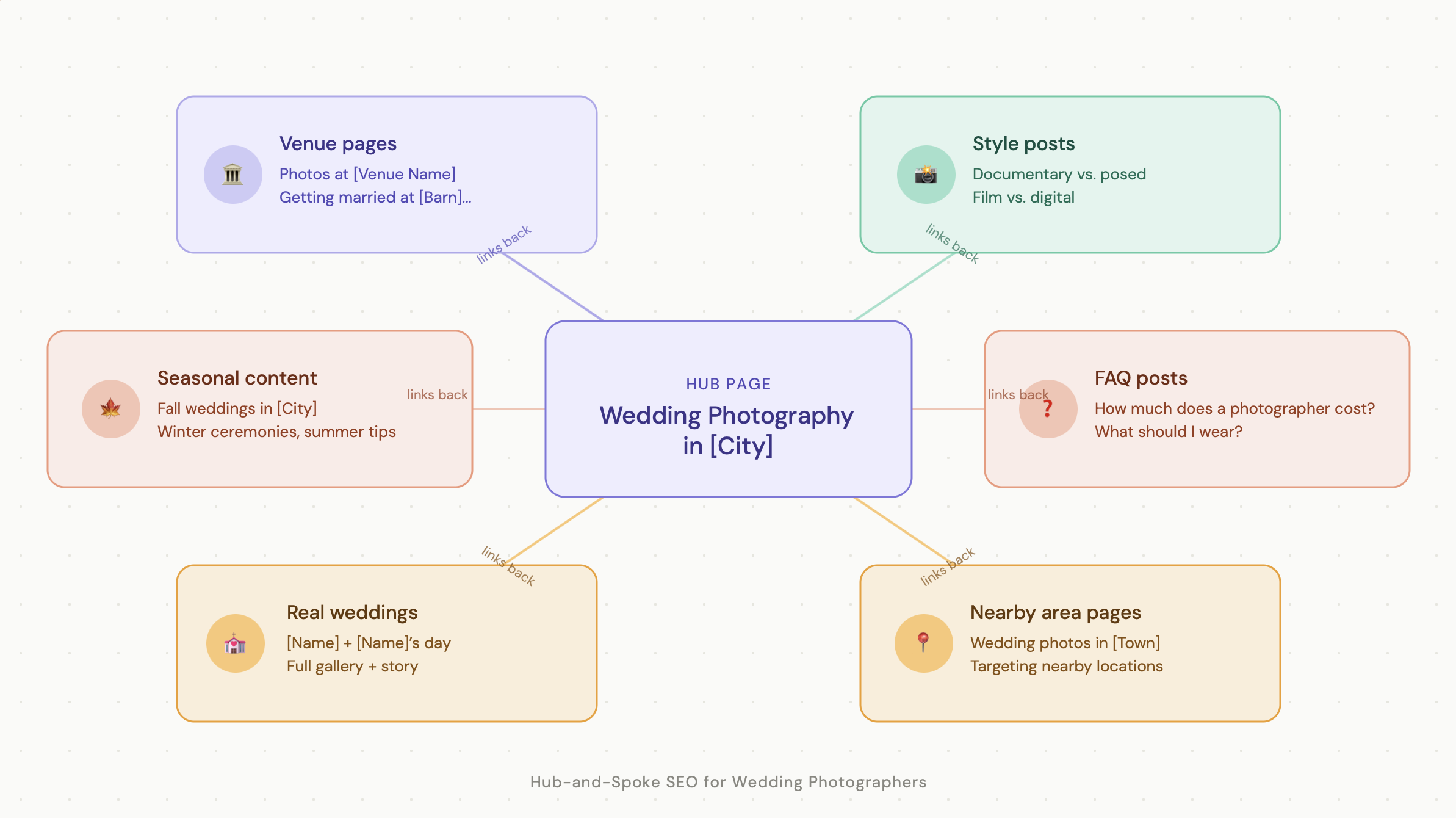
The Hub Page for Wedding Photographers
Your hub is your primary service page, usually something like “Wedding Photography in [City].” This is the page you want to rank for your highest-value keyword.
A good hub page is comprehensive. It covers who you are, your approach, what clients can expect, pricing ranges, testimonials, and a gallery of your best work. It is not a blog post. It is a landing page with real depth, somewhere between 1,000 and 2,000 words.
The hub should also link out to all your spokes, treating them as natural extensions of the information. Think of it as the table of contents for your whole site.
If you are not sure whether your current website can support this kind of structure, Showit is built specifically for photographers and makes it easy to build both service pages and a blog under one roof without touching code.
The Spokes
Each spoke is a focused piece of content that targets a narrower, more specific keyword. These are easier to rank for than your main keyword, they bring in relevant traffic, and every one of them passes link equity back to your hub.
Venue pages
A post for every venue you have shot at. “Wedding Photos at [Estate Name],” “Getting Married at [Barn Venue]: What the Day Looks Like,” and so on. Couples search for their venue by name constantly. These pages answer that search and show your work in context.
Real wedding features
A full gallery and story post for individual couples. These pages rank for long-tail searches like “[Venue] fall wedding” and they also double as social proof. Embed a link back to your hub in a natural way, something like “If you are planning a wedding in [City], here is how to work with me.”
Style and approach posts
Content that answers the “how do you shoot” question: documentary vs. posed, film vs. digital, what golden hour looks like in your work. These pull in couples who are still deciding on a photographer style, and they position you as an educator, not just a vendor.
Seasonal and timing content
“What Fall Weddings Look Like in [City],” “Why I Love Shooting Winter Ceremonies,” “Outdoor Summer Weddings: What to Expect.” These capture seasonal search intent and give you an excuse to show off work from across your portfolio.
FAQ posts
“How Much Does a Wedding Photographer Cost in [City]?” is one of the most searched questions in this industry. Write it. Answer it honestly. These posts pull in high-intent traffic from couples who are actively budgeting.
Nearby area pages
If you travel to surrounding towns and counties, build a page for each one. “Wedding Photography in [Nearby Town]” does not need to be long, but it should be specific, include real photos from that area, and link back to your main hub.
How the Links Flow
Every spoke links back to your hub with descriptive anchor text, something like “learn more about my wedding photography in [City]” rather than just “click here.” Your hub links out to each spoke in a natural, contextual way.
This internal linking structure does two things. First, it tells Google that these pages are related and that your hub is the authority. Second, it gives visitors a clear path deeper into your site, which reduces bounce rates and increases the time they spend with your content.
Getting Images Ready to Publish Faster
One of the biggest reasons photographers do not blog consistently is the editing bottleneck. A gallery from a full wedding day takes hours to cull and edit, and by the time it is done, the momentum to write about it is gone.
AI editing tools have changed this significantly. ImagenAI learns your specific editing style and applies it automatically, and you can get started with 1,500 free edits to see how it fits your workflow. Aftershoot handles both culling and editing and takes a serious chunk of time off turnaround, with 10% off for new users. Either one makes publishing real-wedding blog posts a much more realistic habit.
Keeping Track of It All
Once you have six or eight spokes published, staying on top of your content, your clients, and your business at the same time gets complicated. This is where a good CRM earns its keep.
Sprout Studio is built specifically for photographers and combines studio management, client communication, contracts, and galleries in one place. Dubsado is a strong alternative with very flexible workflow automation, and HoneyBook is a popular pick for photographers who want something intuitive right out of the box. All three free up the backend of your business so you can actually find time to write.
How to Build It Without Burning Out
You do not build this all at once. A realistic approach:
Start with the hub page if you do not already have a strong one. Then add one spoke per month. Prioritize venue pages first since they capture high-intent, specific searches and give you a clear reason to publish real work. From there, rotate between FAQs, seasonal content, and real wedding features.
After 12 months you will have a hub and 12 spokes. After two years, 25. That cluster of content starts to compound. Pages reference each other, authority builds across the whole cluster, and ranking for your primary keyword becomes significantly more achievable.
The One Mistake to Avoid
Publishing spokes that never link back to the hub. It happens constantly. A photographer writes a beautiful real-wedding feature and it floats in isolation with no internal links pointing anywhere useful. Every spoke needs at least one contextual link back to your hub. That is the whole point of the model.
The hub-and-spoke approach works because it mirrors how couples actually search: broadly at first (“wedding photographer in [City]”), then narrowly as they narrow down their venue, style, and budget. If you have content at every stage of that journey, you show up at every stage of that journey.
Some links in this post are affiliate links. If you purchase through them, I may earn a small commission at no extra cost to you. I only recommend tools I genuinely think are worth your time.

