
If you have been spending hours on your blog posts and gallery pages without touching your alt text, you are leaving one of the simplest SEO wins on the table. Alt text is small, easy to write, and almost always overlooked, which means getting it right gives you a real advantage over the photographers in your market who are not thinking about it at all.
This is not a technical post. You do not need to understand how search algorithms work to do this well. You just need to know what to write, how to write it, and why it matters for the couples finding you on Google.
What Alt Text Actually Is
Alt text, short for alternative text, is a written description attached to an image on your website. It shows up in two scenarios: when an image fails to load for a visitor, and when a search engine is crawling your site.
Why Search Engines Need It
Google cannot see images the way people do. When a search engine crawls your website, it reads the alt text attached to each photo in order to understand what is in it. If your images have no alt text, Google has no context. It knows there is a photo, but it does not know if it is a detail shot from a ceremony at a vineyard in Napa or a reception at a ballroom in Boston.
Why Accessibility Needs It Too
Screen readers use alt text to describe images to visitors with visual impairments. Writing good alt text is also just good practice for making your website usable by everyone. It is worth doing for that reason alone, and the SEO benefit is a bonus.
Why Alt Text Matters Specifically for Wedding Photographers
Most wedding photography websites are built primarily around images. Your portfolio, your blog posts, your gallery pages are all photo-heavy, which means alt text is doing a lot of heavy lifting on your site compared to a business that relies mostly on written content.
It Helps You Rank for Venue and Location Keywords
One of the most valuable things alt text can do for a wedding photographer is reinforce your location and venue keywords across every image on your site. If a couple searches for “wedding photographer at Terrain at Styer’s” and your blog post includes ten images with thoughtfully written alt text that names that venue, Google has strong signals that your page is relevant to that search.
It Supports Your Blog Posts
When you write a real wedding blog post, you are likely uploading dozens of photos. Each one is an opportunity to include a keyword phrase that supports the rest of your content. Alt text layers on top of your headlines, your body copy, and your image file names to paint a full picture for search engines.
What Makes Bad Alt Text
Before getting into what to write, it helps to know what to avoid. These are the most common mistakes photographers make.
Leaving It Blank
An image with no alt text is essentially invisible to Google. Your website might be full of stunning photos, and if none of them have alt text, search engines are working without any of the context they need to rank your pages.
Keyword Stuffing
Alt text that reads like “wedding photographer wedding photos wedding couple wedding venue photographer” is not going to help you. Google is sophisticated enough to recognize that as spam, and it can actually work against you. Write for clarity, not repetition.
Using File Names as a Substitute
File names like “IMG_4839.jpg” or “DSC0023.jpg” communicate nothing. While renaming image files with descriptive names is also a good SEO practice, that is separate from writing alt text. Both matter, and neither replaces the other.
Being Too Vague
Alt text like “couple” or “wedding ceremony” is technically not blank, but it is close to useless. It does not tell Google where, who, or what kind of moment it was. The more specific you can be without being excessive, the better.
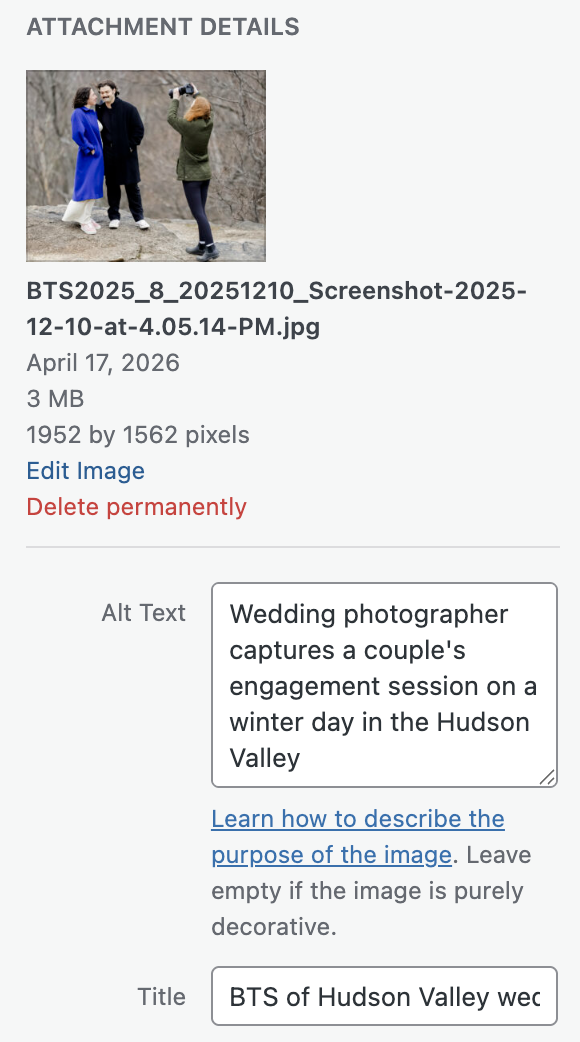
How to Write Alt Text for Wedding Photos
Good alt text for a wedding photo does three things: it describes what is in the image, it includes a relevant keyword where it fits naturally, and it stays concise.
The Formula to Follow
Think of it this way: describe the image + include the couple, venue, or location + add the keyword where it makes sense.
Here are a few examples:
Ceremony shot: “Bride and groom exchanging vows during an outdoor ceremony at The Barn at Gibbet Hill in Groton, Massachusetts”
Detail shot: “Bridal bouquet of white ranunculus and garden roses resting on a windowsill at Willowdale Estate in Topsfield, Massachusetts”
Reception shot: “Couple sharing their first dance on the terrace at Terrain at Styer’s in Glen Mills, Pennsylvania”
Portrait: “Bride and groom walking through the vineyard at Saltwater Farm Vineyard in Stonington, Connecticut wedding photographer”
Notice what all of these have in common: they describe the actual image, they name a specific venue or location, and they read like a natural sentence. None of them sound like a list of keywords forced together.
How Long Should Alt Text Be?
Keep it under 125 characters when possible. Screen readers often cut off after that point, and longer alt text starts to feel more like a keyword dump than a description. If you cannot describe the image in one clear sentence, break it down to the most important elements.
Should Every Image Have Alt Text?
In an ideal world, yes. In practice, prioritize the images that support your most important pages first: your homepage hero image, your portfolio gallery, and your blog posts. If you are blogging a real wedding at a venue you want to rank for, every photo in that post is worth describing.
Putting It Into Practice
Getting into the habit of writing alt text takes a few minutes at the start, and then it becomes second nature. Here is how to build it into your workflow.
Write It When You Upload
The easiest time to write alt text is when you are uploading images to your website. Most website platforms give you a field for it right in the upload interface. If you wait until later, you are much less likely to go back and do it.
Showit makes this straightforward. Because Showit sites run on WordPress under the hood, you have full control over your image metadata, including alt text, file names, and titles, all in one place. For wedding photographers who want a beautiful site without sacrificing SEO functionality, it is the platform I consistently recommend.
Create a Simple Template
For blog posts, you can create a basic alt text template to speed things up. Something like:
“[What is happening] at [venue name] in [city, state] wedding photographer”
You will not use that exact structure for every image, but having a starting point keeps the process moving when you are uploading forty photos from a single wedding.
Use Your CRM to Stay Organized
The more organized your workflow, the easier it is to stay consistent with SEO tasks like this one. When your client details, venue information, and shooting location are all in one place, you are not hunting for the right spelling of a venue name or trying to remember what city a wedding took place in when you are writing alt text six weeks later.
Tools like Sprout Studio, Dubsado, and HoneyBook keep all of your client and event details organized so that when it comes time to blog and write alt text, the information you need is right there. That kind of backend organization makes the front-end SEO work much less painful.
A Quick Checklist Before You Publish
Before your next blog post or gallery page goes live, run through this:
Every image has alt text written out. No image uses the file name as a substitute. Alt text describes the image and includes a venue or location where relevant. No alt text is longer than 125 characters. No keyword is repeated in every single image description.
If you can check all of those off, you are doing better than the majority of wedding photographers publishing content online.
The Bigger Picture
Alt text is one piece of a larger SEO strategy, but it is one of the most overlooked ones. Most photographers are competing on the same keywords with the same blog post structure and the same general website layout. Getting the technical details right, including alt text, gives you an edge that quietly compounds over time.
Every image you upload with thoughtful alt text is another signal to Google about who you are, where you work, and what kind of weddings you photograph. Over weeks and months and years of blogging, those signals add up.
Start with your next blog post. Write the alt text as you upload each photo. Keep the venue name, the city, and the moment in mind. Publish it. Then do it again.
Let’s Work Together
If this resonated with you, we might just be a great fit. I help creative businesses get noticed online through web design, SEO, copywriting, social media, and more. Whether you know exactly what you need or you are still figuring it out, I would love to have a conversation. Scroll down for my contact form to get started!
Disclosure: Some links in this post are affiliate links. I only recommend tools and platforms I truly believe in.

