
Here is the uncomfortable truth about your About page: your potential clients do not care about you. Not yet, anyway. They care about whether you understand them. Whether you get what they want their wedding day to feel like. Whether you will make them feel comfortable in front of a camera. Whether they will actually enjoy spending one of the most important days of their lives with you.
The moment you flip the script on your About page and write it for your dream client instead of about yourself, everything changes. Inquiries go up. The couples who reach out are already sold. And you stop wasting hours on consultations that go nowhere.
This guide walks you through exactly how to write an About page that does that job beautifully.
First: Understand What Your About Page Is Really For
Your About page is a sales page in disguise. It is the page where your dream client decides “yes, this is my photographer.” That does not happen by reading a list of facts about you. It happens when they feel seen, understood, and drawn to who you are as a person.
Think of your About page as a first date. You are not handing someone your resume. You are making them feel comfortable, showing them who you are, and giving them a glimpse of what it will be like to work with you.
Your About page is doing its job when a couple lands on it, reads it, and thinks: “This person gets exactly what we want.”
That is the bar to aim for. Not impressive. Not comprehensive. Resonant.
The Anatomy of an About Page That Converts
1. A Headline That Speaks Directly to Your Client
Most photographers open with “Hi, I’m [Name] and I’m a wedding photographer based in [City].” That is the About page equivalent of a limp handshake. It tells the visitor nothing they did not already know, and it misses a chance to immediately hook them.
Your headline should do one thing: make your ideal client feel like you are talking to them.
Instead of: “Hi, I’m Sarah, a wedding photographer based in Nashville.”
Try something like: “For couples who want their wedding photos to feel like them, not like everyone else’s.”
Lead with what you do for them, not what you are.
2. Open With Their Story, Not Yours
Your first paragraph should make your ideal client nod their head. Describe them. Describe what they want their wedding to feel like. Describe the little things that matter to them. When someone reads this and thinks “how does she know exactly what I want,” you have them.
Think about who your ideal couple is. Are they adventurous and want to ditch the formal portraits for something that feels alive? Are they sentimental and want to capture the small quiet moments more than the posed ones? Are they planners who want a photographer who brings calm and direction? Write that person into existence in your opening paragraph.
Quick exercise: Look at your favorite five weddings you have shot. Write down three words to describe each couple. Find the pattern. That pattern is your ideal client, and that is who you are writing to.
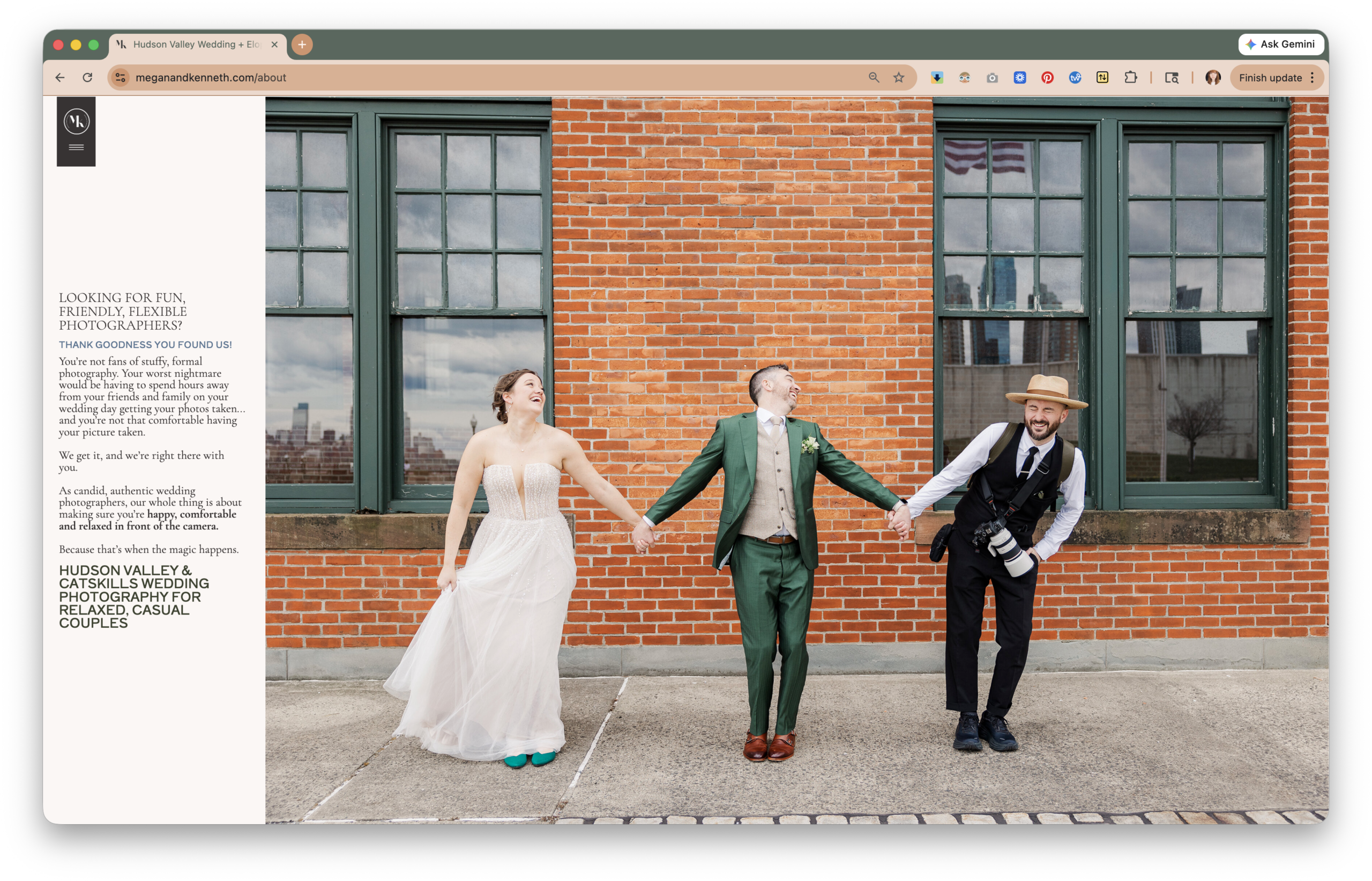
Sample ‘About Page’ opener from Megan & Kenneth
3. Tell Your Story, But Make It About Them
This is where most photographers get it right in spirit but wrong in execution. Yes, share your story. But connect every piece of it back to the client experience.
Do not just say you have been shooting for ten years. Say you have spent ten years learning how to make people who hate being photographed feel completely at ease. Do not just say you fell in love with photography on a trip to Italy. Say that trip is why you believe the messy, unplanned, in-between moments tell a better story than any posed shot ever could.
Every fact about you should have a “which means for you…” attached to it, even if you do not write those words out loud.
4. Show Your Personality With Specific Details
Personality is what makes couples hire you instead of another photographer with a similar portfolio. Generic personality details do not do anything. Being specific is what creates connection.
- Generic: I love coffee, travel, and golden hour.
- Specific: I have strong opinions about the correct ratio of oat milk to espresso, I will cry at your ceremony before your mother does, and I have shot weddings in fourteen states because I will go wherever love takes me.
Specific details make you real. They give couples something to relate to, something to mention in their inquiry, and something to remember you by. Couples are also choosing a person to spend their wedding day with. Let them see that person.
5. Describe Your Approach and What It Feels Like to Work With You
Your future clients are wondering: what will it actually be like on the day? Will you be telling me where to stand all the time? Will you be invisible? Will you hype me up or give me quiet direction?
Answer these questions before they have to ask. Describe your shooting style not just aesthetically (editorial, documentary, light and airy) but experientially. What does it feel like to be photographed by you?
Example: “I am not going to ask you to look at the camera and smile. I am going to whisper something silly in your partner’s ear and then back up and wait for what happens next. My job is to disappear into your day so you can actually live it, and then give you back the proof that you did.”
This kind of writing sells the experience before a single consultation happens.
6. Weave In Credibility Naturally
Testimonials, press features, number of weddings shot, and styled shoots all build trust. But dropping them in a bulleted list feels like a resume. Weave them in naturally.
A line like “After photographing over 200 weddings, I still cry at every single first look” does two things at once: it establishes experience and it communicates genuine heart. That is more powerful than “200+ weddings shot” ever could be.
If you have been featured in publications, mention it conversationally. If you have a glowing testimonial that speaks directly to the experience of working with you, pull a short, punchy line from it and place it near your description of your approach.
7. Photos of Your Face
This sounds obvious, but the number of About pages with zero photos of the photographer is staggering. Couples are choosing to spend their entire wedding day with you. They want to see your face. They want to like you before they email you.
Include at least two or three photos of yourself that feel true to who you are. Not stiff headshots. Photos of you laughing, working, in your element. A behind-the-scenes shot at a wedding. A photo of you doing something you love. These images do as much work as your words.
8. Make It Beautiful (Yes, That Matters Too)
All the SEO in the world will not save a website that makes visitors click away in three seconds. First impressions are real, and in the photography industry, your website is a direct reflection of your creative eye. If it looks dated, cluttered, or generic, potential clients will assume your work is too. A well-designed website builds trust instantly and keeps people on your pages long enough to actually inquire, which is a signal Google pays attention to as well. If you are ready for a site that looks as good as your portfolio deserves, Showit is the platform I recommend to photographers. The design freedom is unmatched, and because it integrates with WordPress, you are not trading beauty for SEO. You genuinely get both.
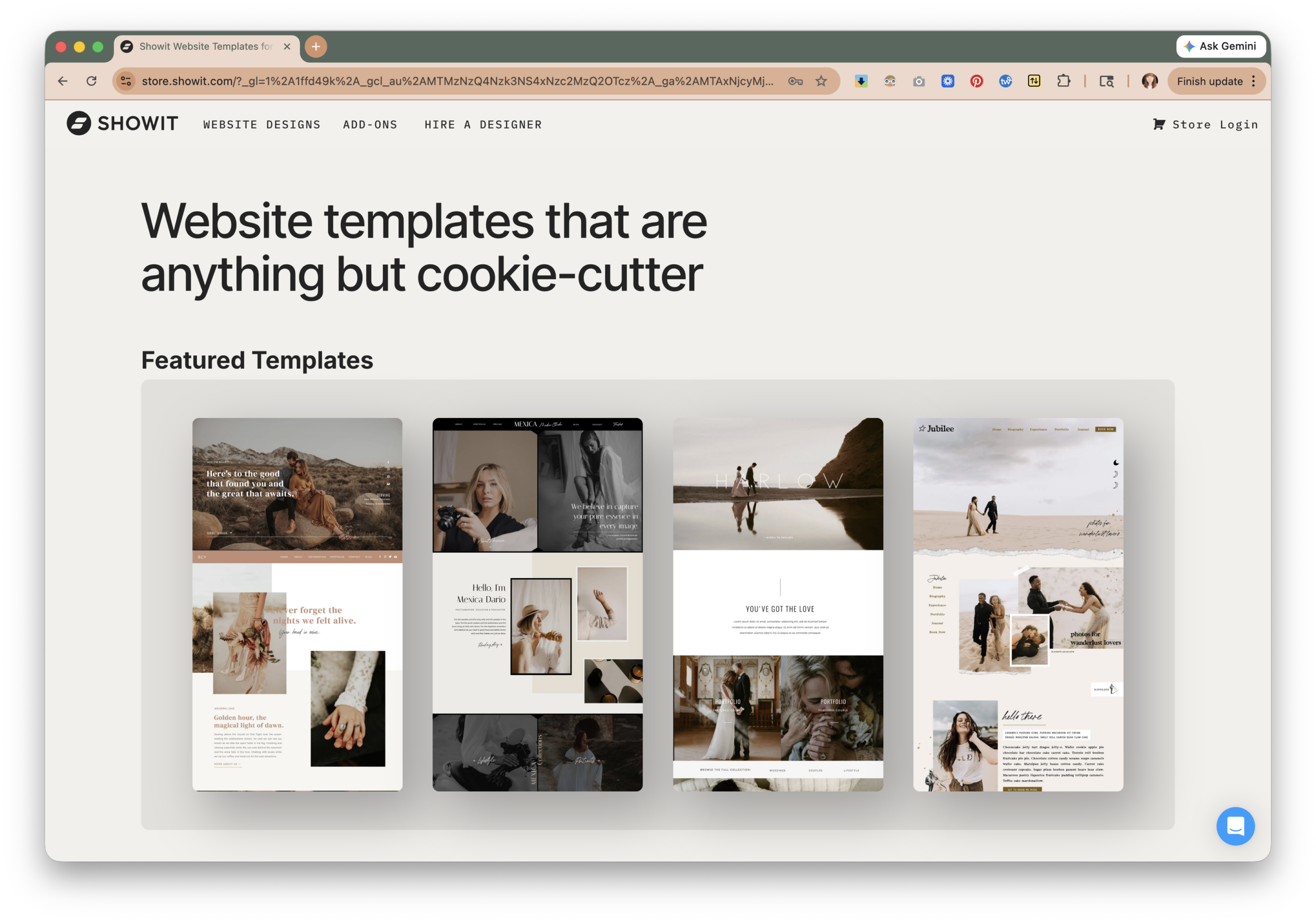
Samples of Showit templates for creatives
9. A Strong Call to Action
End your About page with a clear next step. Not a vague “feel free to reach out.” A warm, specific invitation that makes clicking feel easy and exciting.
Example: “If you are reading this and thinking ‘she gets it’ then I would love to hear from you. Tell me about your wedding, your love story, and what kind of photos you have always dreamed of having. I cannot wait to meet you.”
Do Not Forget the Contact Form
Your About page is doing its hardest work to convince a couple that you are their photographer. Do not make them click away to find you. Put a contact form directly on the page, or at minimum a very obvious button that leads to one.
The same logic applies to every page on your website. A potential client should never have to hunt for a way to reach you. If they want to inquire, the door should be right there, open.
For a streamlined client experience from inquiry all the way through to delivery, these two platforms make it easy to embed and manage contact forms beautifully:
- Sprout Studio (all-in-one CRM and studio management built for photographers)
- Dubsado (automate your client workflow with beautiful, customizable forms)
Both platforms let you create fully branded inquiry forms and automate your follow-up so no lead ever falls through the cracks. Set it up once and let it work for you around the clock.
Common About Page Mistakes to Avoid
- Making it too long. If your About page requires a table of contents, it is too long. Aim for enough to connect, not enough to overwhelm. A few hundred words and great images are more effective than a full life story.
- Starting every sentence with “I.” Read it back and count how many times “I” appears at the start of a sentence. Replace at least half of them with “you,” “your,” or “we.” The shift is dramatic.
- Using industry language. Couples are not looking for “timeless editorial imagery with a documentary approach.” They are looking for photos that feel real. Write the way you would actually talk to a client.
- Forgetting to update it. If your About page still reflects where you were three years ago in your business, it is working against you. Revisit it seasonally and make sure it represents who you are right now.
- No personality. If your About page could belong to any photographer, it belongs to none of them. The goal is for your ideal client to read it and feel like they already know you.
- Burying the call to action. Do not put your contact form link in tiny text at the very bottom. Make it easy, warm, and obvious. Repeat it more than once if the page is long.
A Note on SEO
While the primary job of your About page is to connect with real humans, it also needs to be findable. A few things to keep in mind:
- Include your city and region naturally in the copy. “I am based in Austin, Texas and travel anywhere love calls me” does more than a keyword-stuffed footer.
- Give your page a title tag like “About [Your Name] | Wedding Photographer in [City]” rather than just “About.”
- Name your images with descriptive file names (yourname-wedding-photographer.jpg, not IMG_4823.jpg) and fill in the alt text.
- Link from your About page to your portfolio and contact page so visitors have clear next steps and search engines can crawl the connection.
The About Page Formula, Simplified
- A headline that speaks to your ideal client’s desire
- An opening paragraph that describes them and makes them feel seen
- Your story connected to what it means for them
- Your personality in specific, memorable details
- Your approach described experientially, not just stylistically
- Credibility woven in naturally
- Photos of your face that feel like you
- Make it beautiful with a template from Showit
- A warm, specific call to action
- A contact form right there on the page
Follow this structure, write it in your actual voice, and you have an About page that does not just sit on your website. It works for you every single day, turning visitors into inquiries and inquiries into your favorite clients. The couples who are meant to find you are already looking. Make sure your About page is ready to welcome them in.

